The girls' jugs were on their heads, and each dancer only had one; nonetheless, it was a good show.
28 May 2012


15 May 2012
My Bank Thinks “I” Means Idiot, not Interest
They also think that red is a good color in finance.
Alfa Bank (Альфа
Банк) is my bank in Russia. In
case you are wondering, I have not misspelled “alpha.” My bank choice is as unfortunate as the
idiotic and intentional English misspelling of the bank’s name.

My bank account hit by what appears to have been a
systematic fraud operation in Russia:
Somehow, my debit card information and PIN number were compromised and
the result was a multi-thousand dollar theft loss. The same appears to have been true for many
other people, including a few acquaintances, at various banks. To be fair, this
could happen anywhere.
Alfa Bank was good enough to detect fraud after the seventh thousand dollar left my account
but, per a branch manager, the bank could not guarantee the safety of my funds
in the bank at any time. In other words,
the bank manager admitted that Alfa Bank is of the same safety grade as any
random hole in the ground, except that because the word “bank” is in Alfa
Bank’s name, it is a bigger target. This
is not OK and should not happen anywhere.
Let’s award “I1” to
the bank manager for the insanely idiotic nature of her statement.
I2 is
awarded to the same bank manager idiot for instructing me to file a police
repot for a breach in a bank that she manages, so that the police can
investigate the crime. She then said to
wait for 9 months to get the results back.
I am starting to wonder whether I should report her to the police for
criminal negligence.

Welcome to the Alfa VIP Lounge
I3 is
awarded to whichever idiot that designated me as a “VIP Client.” Unsatisfied with the idiot in charge who got
the I1 and I2 awards, I went to a
separate branch to push my case. The
bank staff, having identified me as a VIP Client, put me in a private office
and asked a pretty 19-year-old girl to tend to my needs. I told the girl that she was very nice, but I
needed someone competent and asked her to send the branch manager in.

At Alfa Bank, We Select Our Managers Carefully
Out walked the girl and in walked in a clown. He deserves I4, I5,
and I6.
I4 is
for his shirt: This pudgy self-designated
Romeo was wearing a very tight, multi-colored Tommy Hilfiger polo over his
budging belly. When I say multicolored,
I mean that each sleeve had a different primary color, as did his collar. And for some weird reason, his shirt was
stitched together in the middle with yet fabric of different color. It was like watching a TV color test
screen. Befittingly, he disseminated
just as much useful content.

My Fashion, My Brain
I5 is
for the clown’s necktie. As if his shirt
was not offensive enough, dumbbell the banker also sported a weirdly knotted
tie that was just long enough to fit only an 11-year-old choirboy properly,
with the tip just hovering above his protruding tummy. And as difficult as it seems, none of the
colors of his tacky tie matched any of the gazillion colors of his stupid
shirt. I mean: Come on!
The clown noticed that I was agitated. He heard my story and tried to console
me. This effort gets him an I6. Without reviewing any documentation, he said
to come back after 70 days to know where the bank investigation has led. Bank investigation? Really?
I thought I had to file a police so that they could analyze the bank’s
failings. Does the bank have any
sort of process, or train any of its managers on process?
Here is a tidbit for others who find themselves in a
similar situation as me: By Russian law,
a bank is obliged to answer to a consumer demand similar in nature to mine within
10 days. If the bank refuses to
compensate the consumer for fraudulent losses, the consumer has the option of
suing the bank in a Russian court. In
most cases, the court sides with the consumer.
How did I learn this? A former Alfa
Bank operations manager, who left the company for greener pastures, confirmed this information
nugget. Somehow, existing Alfa Bank
managers seem to be oblivious to this.
Maybe the first bank manager was right, and my I1 award was
undeserved: Alfa Bank is about as good
as a hole in the ground. In any case,
the bank deserves a new, more descriptive logo (luckily, it still preserves
their red color scheme).

Alfa Bank: Operational Excellence
Alfa Bank, just FYI:
Red in financial parlance means “loss.”
At least, your color is accurately descriptive.
07 May 2012
Made in China, Almost Mexican

Here comes the TACOS steamroller. Sorry, my error. It is the TC4OS kind.
Thievery, Mastery, and Artistry
Approximately one year ago, I was walking in downtown Moscow, less than half a mile away from the Kremlin. Three men, without any apparent connection, were walking towards me almost in a single file. The first dropped something as he passed me. The second picked up the dropped package, appearing to be a stack of $100 bills, and asked me, with an innocent smile and a bushy tail, whether this were my money. As I was explaining that he package probably belonged to the first man, the third man approached the second man and me, showed a police badge, and started to interrogate me. The expectation was that I pay a "bribe" to the police, bogus or real, to get out of the sticky trap. I just walked away. The thievery attempt was clumsy by common street crooks and cons trying to make a quick coin.
Approximately a month ago, I returned to Russia from abroad with two new, unopened iPads in my luggage. The Russian customs at Domodedovo, a flagship airport in Russia, asked me to place my suitcase in the X-ray machine. I complied. A customs official ordered me to open my luggage and took intense interest in a single, white tube sock. Puzzled, I asked why thy liked my sock so much. The focused changed immediately to a handful of vitamin pills I had in the luggage. Puzzled again, I explained that those were vitamins. The customs official was then satisfied, quickly zipped up my bag, and allowed me to enter Russia. I arrived home, opened my luggage, and found that the two iPads were missing. The focus on the tube sock and vitamins, however brief, was a diversion. This is more than common thievery by street hoodlums; this is mastery by government law-enforcment officials. Hats off to Russian Customs.
Exactly yesterday, I received a call from my Russian bank asking if I had made multiple, large ATM withdraws in quick succession. I answered "no" and asked for my account to be blocked. As it turns out, someone had replicated both my ATM card and matched it to my PIN code, thereby getting unfettered access to my account. The probable methods of getting both pieced of information are: (1) someone in the bank leaked the information; (2) someone hacked the bank's security and stole this information pair; or (3) someone hacked an ATM to get the card data as well as using surveillance of some sort to get my PIN code, and then went to town with it. If (1) is true, then this is a case of bank fraud. If (2) is true, then we have a case of negligence by my bank. If (3) is true, and because I only use large, well-known bank's ATMs, there is a fundamental problem with the integrity the banking system here. There is no good possibility.
Summary:
What's the next growth echelon after artistry? Whatever it is, I do not like where this is going.
- Category: Thievery
- Expected Loss: Multiples of tens of dollars
- Actual Loss: $0
Approximately a month ago, I returned to Russia from abroad with two new, unopened iPads in my luggage. The Russian customs at Domodedovo, a flagship airport in Russia, asked me to place my suitcase in the X-ray machine. I complied. A customs official ordered me to open my luggage and took intense interest in a single, white tube sock. Puzzled, I asked why thy liked my sock so much. The focused changed immediately to a handful of vitamin pills I had in the luggage. Puzzled again, I explained that those were vitamins. The customs official was then satisfied, quickly zipped up my bag, and allowed me to enter Russia. I arrived home, opened my luggage, and found that the two iPads were missing. The focus on the tube sock and vitamins, however brief, was a diversion. This is more than common thievery by street hoodlums; this is mastery by government law-enforcment officials. Hats off to Russian Customs.
- Category: Mastery
- Expected Loss: $0
- Actual Loss: Multiples of hundreds of dollars
Exactly yesterday, I received a call from my Russian bank asking if I had made multiple, large ATM withdraws in quick succession. I answered "no" and asked for my account to be blocked. As it turns out, someone had replicated both my ATM card and matched it to my PIN code, thereby getting unfettered access to my account. The probable methods of getting both pieced of information are: (1) someone in the bank leaked the information; (2) someone hacked the bank's security and stole this information pair; or (3) someone hacked an ATM to get the card data as well as using surveillance of some sort to get my PIN code, and then went to town with it. If (1) is true, then this is a case of bank fraud. If (2) is true, then we have a case of negligence by my bank. If (3) is true, and because I only use large, well-known bank's ATMs, there is a fundamental problem with the integrity the banking system here. There is no good possibility.
I presented the case to a bank manager yesterday shortly after the event. Her response was: "Sorry, the bank cannot guarantee the safety of your funds." Her statement was tantamount to "one cannot reasonably expect that his money will be in his account tomorrow or the next day. Caveat emptor, and good luck."
This situation is so mind boggling and unsettling that it can only be explained as artistry. This artistic presentation makes a clear impression that nothing can be taken for granted.
- Category: Artistry
- Expected Loss: Negative dollars; in actuality, one should earn interest.
- Actual Loss: Multiples of thousands of dollars
Summary:
| Category | Expected Loss | Actual Loss |
| Thievery | Multiples of tens of dollars | $0 |
| Mastery | $0 | Multiples of hundreds of dollars |
| Artistry | None; actually a gain is expected | Multiples of thousands of dollars |
What's the next growth echelon after artistry? Whatever it is, I do not like where this is going.
14 April 2012
Bad Governance and Good Friendships
The social fabric is considerably different in US than in Russia. For the sake of simplicity, I will narrow this discussion to two circles: One small, consisting of family and friends, the other one large, consisting of the society at large.
In Russia, the smaller circle is far more integrated and tightly knit than its counterpart in the US. Russian relationships in this circle are deep and loyal. Individuals - sisters, sons, aunts, schoolmates, and so forth - go out of their way to be supportive. They sacrifice themselves to contribute to their network in a manner should be the envy of any American.
In America, this circle exists but there is far less reliance on the network to get things done. Family members do support each other, but it is normal for them to handle financial transactions contractually. There are close American friends who sacrifice their own comfort for the sake of their friends' wellbeing exist, but this type of friendship is far more common in Russia.
Expand the circle to include the society at large, and the picture changes dramatically. While this is an oversimplification, it is not out of bounds to describe that there is very little trust in this big circle in Russia. Per my observation, an operating assumption in Russia is that any person outside of my inner circle is out to get ahead at my expense; as such, I may take preemptive action and attempt to cement my advantage where needed. This behavior is seen in daily situations, such as queues. In the US, people normally line up in order of arrival; this is an understood social norm. In Russia, the wily one who manages to cut in line and aggressively demands that his case takes priority gets ahead. The behavior is also seen in business affairs where the concept of a "win-win" deal is lost to most people.
In the American society, it is understood that if someone is cheated or gets an unfair deal, he has a functioning legal and law-enforcement structure on which he can depend. There are small claims courts, precedents, arbitration mechanisms, and so forth that facilitate social functions. While these facilities exist in Russia, they are far more susceptible to manipulation and corruption (by the wily one).
Some of my American friends and family members have put forth a "constant social change" argument. Per this argument, America's expanding multi-cultural nature is to blame for the lack of a tighter, more coherent social bond in the inner circle. The explanation is that because there are so many different subcultures and backgrounds in the country, and there is a constant push for liberalization, the notion of "family" is being reinvented continuously (through interracial marriages or, more recently, through same-sex marriages). This constant change creates confusion and confusion weakens tight social bonds in the inner circle.
Perhaps, there is something to this explanation; assuming that this argument is true, one natural conclusion is that tolerance and adaptability has certain costs, some of which are negative and lamentable given the weakened inter-friend and inter-family bonds. But, this explanation has musk of offensiveness, insofar as it implies that tolerance and extending the same legal rights to all social subclasses is undesirable at some level. In the current political climate, it is difficult to explore this angle seriously, as anyone who pontificates and expounds on this theme is at risk of being called a racist or a bigot, regardless of his intentions. For Russian readers not familiar with the US culture, the "racist" label is an anathema that can kill careers and lead to social seclusion in the mainstream.
Be that as it may, "constant social change" argument does not address why the larger American societal circle is more tightly interwoven than the one in Russia. Another explanation is that because there is a strong legal and law-enforcement structure that harmonizes relationships between individuals in the US, there is a lesser need for reliance on the inner circle of family and friends. This lack of need leads to weaker bonds between friends and family than otherwise would exist. Conversely, a more tightly integrated inner circle of friends and family is needed in order to compensate for a weaker social order structure, as provided by predictable, transparent laws and responsible law-enforcement public servants.
This explanation captures the differences of strength between the smaller circle of friends and family and the larger society in US and Russia. It also maps well to my experience around the world: Where there are strong, consistent states that serve the public, as in Northern Europe, there is a lesser dependency on friends and family. Conversely, where there are stronger friends and family bonds, governments tend to be weaker, less predictable, and more self-serving, as in the Middle East or Latin America.
So, as it turns out, a benefit of bad government is good friends.
In Russia, the smaller circle is far more integrated and tightly knit than its counterpart in the US. Russian relationships in this circle are deep and loyal. Individuals - sisters, sons, aunts, schoolmates, and so forth - go out of their way to be supportive. They sacrifice themselves to contribute to their network in a manner should be the envy of any American.
In America, this circle exists but there is far less reliance on the network to get things done. Family members do support each other, but it is normal for them to handle financial transactions contractually. There are close American friends who sacrifice their own comfort for the sake of their friends' wellbeing exist, but this type of friendship is far more common in Russia.
Expand the circle to include the society at large, and the picture changes dramatically. While this is an oversimplification, it is not out of bounds to describe that there is very little trust in this big circle in Russia. Per my observation, an operating assumption in Russia is that any person outside of my inner circle is out to get ahead at my expense; as such, I may take preemptive action and attempt to cement my advantage where needed. This behavior is seen in daily situations, such as queues. In the US, people normally line up in order of arrival; this is an understood social norm. In Russia, the wily one who manages to cut in line and aggressively demands that his case takes priority gets ahead. The behavior is also seen in business affairs where the concept of a "win-win" deal is lost to most people.
In the American society, it is understood that if someone is cheated or gets an unfair deal, he has a functioning legal and law-enforcement structure on which he can depend. There are small claims courts, precedents, arbitration mechanisms, and so forth that facilitate social functions. While these facilities exist in Russia, they are far more susceptible to manipulation and corruption (by the wily one).
Some of my American friends and family members have put forth a "constant social change" argument. Per this argument, America's expanding multi-cultural nature is to blame for the lack of a tighter, more coherent social bond in the inner circle. The explanation is that because there are so many different subcultures and backgrounds in the country, and there is a constant push for liberalization, the notion of "family" is being reinvented continuously (through interracial marriages or, more recently, through same-sex marriages). This constant change creates confusion and confusion weakens tight social bonds in the inner circle.
Perhaps, there is something to this explanation; assuming that this argument is true, one natural conclusion is that tolerance and adaptability has certain costs, some of which are negative and lamentable given the weakened inter-friend and inter-family bonds. But, this explanation has musk of offensiveness, insofar as it implies that tolerance and extending the same legal rights to all social subclasses is undesirable at some level. In the current political climate, it is difficult to explore this angle seriously, as anyone who pontificates and expounds on this theme is at risk of being called a racist or a bigot, regardless of his intentions. For Russian readers not familiar with the US culture, the "racist" label is an anathema that can kill careers and lead to social seclusion in the mainstream.
Be that as it may, "constant social change" argument does not address why the larger American societal circle is more tightly interwoven than the one in Russia. Another explanation is that because there is a strong legal and law-enforcement structure that harmonizes relationships between individuals in the US, there is a lesser need for reliance on the inner circle of family and friends. This lack of need leads to weaker bonds between friends and family than otherwise would exist. Conversely, a more tightly integrated inner circle of friends and family is needed in order to compensate for a weaker social order structure, as provided by predictable, transparent laws and responsible law-enforcement public servants.
This explanation captures the differences of strength between the smaller circle of friends and family and the larger society in US and Russia. It also maps well to my experience around the world: Where there are strong, consistent states that serve the public, as in Northern Europe, there is a lesser dependency on friends and family. Conversely, where there are stronger friends and family bonds, governments tend to be weaker, less predictable, and more self-serving, as in the Middle East or Latin America.
So, as it turns out, a benefit of bad government is good friends.
08 April 2012
Oxymoron
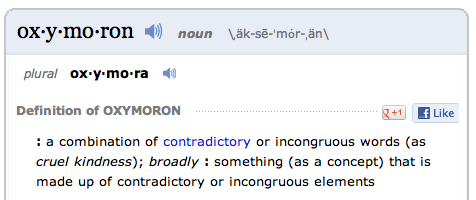
The above clip comes from m-w.com, the online version of Merriam-Webster Dictionary. Put simply, an oxymoron is a contradiction in terms, which brings me to the venerable Russian proverb of "доверяй, но проверяй," or "trust, but verify."
Per Wikipedia:
Trust, but verify was a signature phrase adopted and made famous by U.S. president Ronald Reagan. Reagan frequently used it when discussing U.S. relations with the Soviet Union ... Soviet revolutionary Vladimir Lenin also frequently used the phrase ...
After Reagan used the phrase at the signing of the INF Treaty, his counterpart Mikhail Gorbachev responded: 'You repeat that at every meeting.' To which President Reagan answered, "I like it."Here is the contradiction: If you trust, then there is no need to verify. Hence, the verification after the stated "trust" is, in fact, a statement that there is no trust after all. This makes "доверяй, но проверяй" an oxymoron. It is a polite way of saying: "I don't really trust you, and this is why I will verify."
Knowing President Reagan's anti-communist stance, I understand his usage of the phrase when negotiating with the Soviets. This is precisely why he responded with "I like it."
But, it makes me wonder why this phrase is a venerable Russian proverb.
06 April 2012
Kirill's Miracle: You See It, But It Was Never There

Patriarch Kirill I is the leader of the Russian Orthodox Church; he is an analogous figure to the Pope.
The photos above are from the Church's official site. The one on the right was posted initially and it shows Kirill wearing a $30,000 Breguet watch. Embarrassed by recent criticisms of the Church's ostentatious display of power and wealth, web site editors decided to extend Kirill's sleeve to cover of the watch. The doctored photo, on the left, was placed on the Church's web site.
While the watch may have miraculously disappeared up Kirill's sleeve, it is still miraculously showing its reflection on the tables. The bigger, more incredible miracle has been Kirill's insistance that he never wore the watch in the first place.
Are you a believer now?
05 April 2012
.JPG)
Two Types of Russians
My (Russian) boss once said: "There are two types of people in Russia. There are those that do not know the difference between $1,000 and $1, and there are those that do. The trouble is that only the people that do not know the difference have money to spend."
Those are wise words, especially since they are confirmed by this article in the NY Times. Here are some telling quotes:
Time to Sell Penthouse. The Russians Have Cash.
...
The spending spree may just be warming up, given that $84 billion left Russia last year, with the Russian government estimating that up to 5 percent of that capital flight was being plowed into American real estate.
...
Jill Sloane, a broker with Halstead Property, said, “Everyone knows they are the ones with the big money right now.” She added that when she heard that the penthouse at 15 Central Park West had sold for $88 million, “I knew it had to be a Russian.”
...
Many of the Russians seem determined to make names for themselves as conspicuous consumers. After buying trophy apartments and houses, they often pour tens of millions of dollars more into remodeling projects by brand-name interior designers like Jacques Grange. They also collect rare art and commission one-of-a-kind yachts.
...
When the Russians shop for real estate, they tend not to dither, brokers said, and they seem to spend their fortunes as quickly as they made them.
02 April 2012
Very Puzzling ...
This image comes by way of an advertisement in the Moscow Metro. It makes me wonder ...
Why is Santa Claus, who lives in the North Pole, wearing a Mexican sombrero? I mean, since when does the old man go to Cancun for spring break? How does Dr. Hans Zarkov from Flash Gordon fit into this epic story? If Santa Claus in in Cancun, why isn't Zarkov in a Speedo or something provocatively disgusting befitting of the antagonist? Who is the girl anyway, and why isn't she wearing a bikini?
This seems to have all the trappings of a classic B movie, which means that it must include a gratuitous sex scene. The B movie girl always falls for the good guy at the end of the story, in this case Santa. They will be making love on the Caribbean beach in the sun set ... but does the old man still have it in him?
 \
\
Why is Santa Claus, who lives in the North Pole, wearing a Mexican sombrero? I mean, since when does the old man go to Cancun for spring break? How does Dr. Hans Zarkov from Flash Gordon fit into this epic story? If Santa Claus in in Cancun, why isn't Zarkov in a Speedo or something provocatively disgusting befitting of the antagonist? Who is the girl anyway, and why isn't she wearing a bikini?
This seems to have all the trappings of a classic B movie, which means that it must include a gratuitous sex scene. The B movie girl always falls for the good guy at the end of the story, in this case Santa. They will be making love on the Caribbean beach in the sun set ... but does the old man still have it in him?
 \
\The American-perspective B movie analysis aside, this musical is based on a Pushkin fairly tale about Lukomorye, "a country of fairy-tale magic, light and good, and a great, fabulous oak - a tree of life, with nourishing power of love and kindness for the living world and all humanity." According to the legend, a once-in-a-millennium event breaths new, magical life into Lukomorye but, as with all good, evil forces attempt to stop it. It is a classic good-versus-evil story set in a mystical, magical literary setting (versus a crass, sex-laden, action-packed Hollywood production intended to generate ROI by titillating a subsection of the masses).
Here is a dictionary translating Pushkin's magical characters into American B movie types:
- Oldman Borovichok - Santa Clause in a sombrero; he is a has-been that finds himself in an unusual situation and must make a comeback to save the day and prove that his manliness is still relevant.
- Koschey the Immortal (better translated as "Koschey the Lifeless") - Dr. Hans Zarkov; he is the handsome bad apple, and the character the audience must love to hate.
- Vasilisa the Wise - Semi-central, hot female character that injects the love angle into the story and over whom good and evil must fight. She will show some skin at the end of the game (hint: a wave will blindside the innocent damsel by dampening her T-shirt as she is frolicking on the beach in the closing scene).
I hope this helps bridge the cultural gap.
Subscribe to:
Posts (Atom)