The social fabric is considerably different in US than in Russia. For the sake of simplicity, I will narrow this discussion to two circles: One small, consisting of family and friends, the other one large, consisting of the society at large.
In Russia, the smaller circle is far more integrated and tightly knit than its counterpart in the US. Russian relationships in this circle are deep and loyal. Individuals - sisters, sons, aunts, schoolmates, and so forth - go out of their way to be supportive. They sacrifice themselves to contribute to their network in a manner should be the envy of any American.
In America, this circle exists but there is far less reliance on the network to get things done. Family members do support each other, but it is normal for them to handle financial transactions contractually. There are close American friends who sacrifice their own comfort for the sake of their friends' wellbeing exist, but this type of friendship is far more common in Russia.
Expand the circle to include the society at large, and the picture changes dramatically. While this is an oversimplification, it is not out of bounds to describe that there is very little trust in this big circle in Russia. Per my observation, an operating assumption in Russia is that any person outside of my inner circle is out to get ahead at my expense; as such, I may take preemptive action and attempt to cement my advantage where needed. This behavior is seen in daily situations, such as queues. In the US, people normally line up in order of arrival; this is an understood social norm. In Russia, the wily one who manages to cut in line and aggressively demands that his case takes priority gets ahead. The behavior is also seen in business affairs where the concept of a "win-win" deal is lost to most people.
In the American society, it is understood that if someone is cheated or gets an unfair deal, he has a functioning legal and law-enforcement structure on which he can depend. There are small claims courts, precedents, arbitration mechanisms, and so forth that facilitate social functions. While these facilities exist in Russia, they are far more susceptible to manipulation and corruption (by the wily one).
Some of my American friends and family members have put forth a "constant social change" argument. Per this argument, America's expanding multi-cultural nature is to blame for the lack of a tighter, more coherent social bond in the inner circle. The explanation is that because there are so many different subcultures and backgrounds in the country, and there is a constant push for liberalization, the notion of "family" is being reinvented continuously (through interracial marriages or, more recently, through same-sex marriages). This constant change creates confusion and confusion weakens tight social bonds in the inner circle.
Perhaps, there is something to this explanation; assuming that this argument is true, one natural conclusion is that tolerance and adaptability has certain costs, some of which are negative and lamentable given the weakened inter-friend and inter-family bonds. But, this explanation has musk of offensiveness, insofar as it implies that tolerance and extending the same legal rights to all social subclasses is undesirable at some level. In the current political climate, it is difficult to explore this angle seriously, as anyone who pontificates and expounds on this theme is at risk of being called a racist or a bigot, regardless of his intentions. For Russian readers not familiar with the US culture, the "racist" label is an anathema that can kill careers and lead to social seclusion in the mainstream.
Be that as it may, "constant social change" argument does not address why the larger American societal circle is more tightly interwoven than the one in Russia. Another explanation is that because there is a strong legal and law-enforcement structure that harmonizes relationships between individuals in the US, there is a lesser need for reliance on the inner circle of family and friends. This lack of need leads to weaker bonds between friends and family than otherwise would exist. Conversely, a more tightly integrated inner circle of friends and family is needed in order to compensate for a weaker social order structure, as provided by predictable, transparent laws and responsible law-enforcement public servants.
This explanation captures the differences of strength between the smaller circle of friends and family and the larger society in US and Russia. It also maps well to my experience around the world: Where there are strong, consistent states that serve the public, as in Northern Europe, there is a lesser dependency on friends and family. Conversely, where there are stronger friends and family bonds, governments tend to be weaker, less predictable, and more self-serving, as in the Middle East or Latin America.
So, as it turns out, a benefit of bad government is good friends.
14 April 2012


08 April 2012
Oxymoron
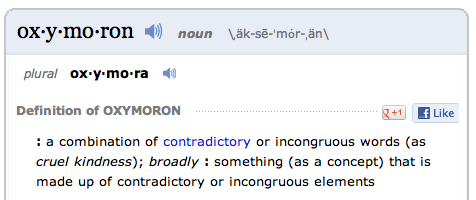
The above clip comes from m-w.com, the online version of Merriam-Webster Dictionary. Put simply, an oxymoron is a contradiction in terms, which brings me to the venerable Russian proverb of "доверяй, но проверяй," or "trust, but verify."
Per Wikipedia:
Trust, but verify was a signature phrase adopted and made famous by U.S. president Ronald Reagan. Reagan frequently used it when discussing U.S. relations with the Soviet Union ... Soviet revolutionary Vladimir Lenin also frequently used the phrase ...
After Reagan used the phrase at the signing of the INF Treaty, his counterpart Mikhail Gorbachev responded: 'You repeat that at every meeting.' To which President Reagan answered, "I like it."Here is the contradiction: If you trust, then there is no need to verify. Hence, the verification after the stated "trust" is, in fact, a statement that there is no trust after all. This makes "доверяй, но проверяй" an oxymoron. It is a polite way of saying: "I don't really trust you, and this is why I will verify."
Knowing President Reagan's anti-communist stance, I understand his usage of the phrase when negotiating with the Soviets. This is precisely why he responded with "I like it."
But, it makes me wonder why this phrase is a venerable Russian proverb.
06 April 2012
Kirill's Miracle: You See It, But It Was Never There

Patriarch Kirill I is the leader of the Russian Orthodox Church; he is an analogous figure to the Pope.
The photos above are from the Church's official site. The one on the right was posted initially and it shows Kirill wearing a $30,000 Breguet watch. Embarrassed by recent criticisms of the Church's ostentatious display of power and wealth, web site editors decided to extend Kirill's sleeve to cover of the watch. The doctored photo, on the left, was placed on the Church's web site.
While the watch may have miraculously disappeared up Kirill's sleeve, it is still miraculously showing its reflection on the tables. The bigger, more incredible miracle has been Kirill's insistance that he never wore the watch in the first place.
Are you a believer now?
05 April 2012
.JPG)
Two Types of Russians
My (Russian) boss once said: "There are two types of people in Russia. There are those that do not know the difference between $1,000 and $1, and there are those that do. The trouble is that only the people that do not know the difference have money to spend."
Those are wise words, especially since they are confirmed by this article in the NY Times. Here are some telling quotes:
Time to Sell Penthouse. The Russians Have Cash.
...
The spending spree may just be warming up, given that $84 billion left Russia last year, with the Russian government estimating that up to 5 percent of that capital flight was being plowed into American real estate.
...
Jill Sloane, a broker with Halstead Property, said, “Everyone knows they are the ones with the big money right now.” She added that when she heard that the penthouse at 15 Central Park West had sold for $88 million, “I knew it had to be a Russian.”
...
Many of the Russians seem determined to make names for themselves as conspicuous consumers. After buying trophy apartments and houses, they often pour tens of millions of dollars more into remodeling projects by brand-name interior designers like Jacques Grange. They also collect rare art and commission one-of-a-kind yachts.
...
When the Russians shop for real estate, they tend not to dither, brokers said, and they seem to spend their fortunes as quickly as they made them.
02 April 2012
Very Puzzling ...
This image comes by way of an advertisement in the Moscow Metro. It makes me wonder ...
Why is Santa Claus, who lives in the North Pole, wearing a Mexican sombrero? I mean, since when does the old man go to Cancun for spring break? How does Dr. Hans Zarkov from Flash Gordon fit into this epic story? If Santa Claus in in Cancun, why isn't Zarkov in a Speedo or something provocatively disgusting befitting of the antagonist? Who is the girl anyway, and why isn't she wearing a bikini?
This seems to have all the trappings of a classic B movie, which means that it must include a gratuitous sex scene. The B movie girl always falls for the good guy at the end of the story, in this case Santa. They will be making love on the Caribbean beach in the sun set ... but does the old man still have it in him?
 \
\
Why is Santa Claus, who lives in the North Pole, wearing a Mexican sombrero? I mean, since when does the old man go to Cancun for spring break? How does Dr. Hans Zarkov from Flash Gordon fit into this epic story? If Santa Claus in in Cancun, why isn't Zarkov in a Speedo or something provocatively disgusting befitting of the antagonist? Who is the girl anyway, and why isn't she wearing a bikini?
This seems to have all the trappings of a classic B movie, which means that it must include a gratuitous sex scene. The B movie girl always falls for the good guy at the end of the story, in this case Santa. They will be making love on the Caribbean beach in the sun set ... but does the old man still have it in him?
 \
\The American-perspective B movie analysis aside, this musical is based on a Pushkin fairly tale about Lukomorye, "a country of fairy-tale magic, light and good, and a great, fabulous oak - a tree of life, with nourishing power of love and kindness for the living world and all humanity." According to the legend, a once-in-a-millennium event breaths new, magical life into Lukomorye but, as with all good, evil forces attempt to stop it. It is a classic good-versus-evil story set in a mystical, magical literary setting (versus a crass, sex-laden, action-packed Hollywood production intended to generate ROI by titillating a subsection of the masses).
Here is a dictionary translating Pushkin's magical characters into American B movie types:
- Oldman Borovichok - Santa Clause in a sombrero; he is a has-been that finds himself in an unusual situation and must make a comeback to save the day and prove that his manliness is still relevant.
- Koschey the Immortal (better translated as "Koschey the Lifeless") - Dr. Hans Zarkov; he is the handsome bad apple, and the character the audience must love to hate.
- Vasilisa the Wise - Semi-central, hot female character that injects the love angle into the story and over whom good and evil must fight. She will show some skin at the end of the game (hint: a wave will blindside the innocent damsel by dampening her T-shirt as she is frolicking on the beach in the closing scene).
I hope this helps bridge the cultural gap.
31 March 2012
Moscow Edges Out New York
Here is a December 2011 survey from The Economist ranking the world's most expensive cities. Moscow still edges out New York, but a "bargain" compared to Zurich, Tokyo, and Oslo. I am grateful, because it could be worse.


30 March 2012
Be Grateful: It Could be Worse
Long ago, in the flat West Texas desert near the New Mexican border, I was stuck in a rather frustrating in situation with a friend. In a moment of calmness, he said: "Always remember this when things are bad: It could be worse."
The words of my friend, Nik, had a certain weight to them. He was born in Yugoslavia in an ethnically mixed house. He and his family relocated to Liberia - once a peaceful country - when Nik was young. He then came to the US where he and I became classmates. Nik's amazing power was being able to stay optimistic despite the anything that was happening in the current situation. I suppose that this is a necessary skill when your parents, one a Serb and the other a Croat, find themselves in opposing sides of a civil war that ends up destroying the country you were born into. And, as it turns out, another civil war destroys the beautiful country of your youth.
Now, let's talk about the weather. Last year, on this day, I complained about Russia's long winter. Soon after my complaint, the sun came out, green shoots popped out, and spring came roaring in. This year, the spring is delayed by just a bit more (by Moscow standards). The weather forecast tells the story (left forecast is in Fahrenheit, right in Celsius).


Yup, snow is in the forecast for another week. As Nik said, "it could be worse." Let's be grateful that it is not.
The words of my friend, Nik, had a certain weight to them. He was born in Yugoslavia in an ethnically mixed house. He and his family relocated to Liberia - once a peaceful country - when Nik was young. He then came to the US where he and I became classmates. Nik's amazing power was being able to stay optimistic despite the anything that was happening in the current situation. I suppose that this is a necessary skill when your parents, one a Serb and the other a Croat, find themselves in opposing sides of a civil war that ends up destroying the country you were born into. And, as it turns out, another civil war destroys the beautiful country of your youth.
Now, let's talk about the weather. Last year, on this day, I complained about Russia's long winter. Soon after my complaint, the sun came out, green shoots popped out, and spring came roaring in. This year, the spring is delayed by just a bit more (by Moscow standards). The weather forecast tells the story (left forecast is in Fahrenheit, right in Celsius).


Yup, snow is in the forecast for another week. As Nik said, "it could be worse." Let's be grateful that it is not.
25 March 2012
Inflation Expectation?
Since my residency began in Moscow over two years ago, the US dollar - Russian ruble exchange rate has been relatively stable and within a 15% range. This would be a wide and volatile range if currencies of developed economies were to be compared, but Russia is a developing economy, making this a tolerable range.

At the same time 10 ruble coins were just coming into existence while 10 ruble bills were just being phased out by the Russian central bank. Attitudes towards Russian change are different now. At least in downtown, kopek coins are almost never traded; 1 and 2 ruble coins seem to have taken their place as the minimally acceptable change. Moreover, when I try to unload a pocket full of change, for example for a bottle of water or a metro ticket, my payment method is universally rejected. Vendors, including those who act on behalf of the government, want to see as few coins as possible.

In the same time period, I have noticed a remarkably different attitude towards change. Upon my arrival, the following coins were readily traded at most grocery stores:
- 10 kopeks (10% of ruble)
- 50 kopeks
- 1,2, and 5 ruble coins

Worth Something Sometime Ago
In the same context, I noticed some retaliatory behavior by vendors. I made a purchase today for 375 ruble. I paid with a 500 ruble bill and included two 10 rouble coins and five 1 ruble coins, expecting a return of 150 rubles with one 100 ruble bill and one 50 ruble bill. After having received the 100 ruble bill, I then received 50 roubles in combinations of 1 and 2 rouble coins. It was as if I were being punished for having put forth the small change.
Comrade, I Ruined This Economy Long Ago
This stands in stark contract with my experience in Western Europe over the previous two weeks, where I spent three different currencies in four different countries. The Brits and Swiss respect their coins and accept them without any question. The Germans and French, despite having been through a euro-style roller coaster as of late, still honor their small change with dignity.
It should also be pointed out that Western Europe has a rather modest inflation, compared to Russia's 8% inflation in 2011. Perhaps, the attitude on Moscow's streets is reflective of expected inflation going forward, and the desire of getting rid of the small change indicative that the populace is gearing up for using larger denominations for smaller purchases.
25 February 2012
Election Posturing
Putin touts nukes, urges US to be more positive
Given the upcoming election and Russia's host of internal problems, this maneuver focusing Russian's attention on an imagined foreign threat is understandable.
However, if the goal is to unlock Russia's potential to become world's third largest economy (discounting EU), investing in nuclear submarines is an extravagant waste.
From a foreign policy perspective, monitoring the ground in the mineral rich Mongolia and Kazakhstan and the influence of these countries' immediate neighbors should be of far more interest to Russia. And, as Al Qaeda has proven, Islamic fundamentalism is stateless, making it an international threat.
The Cold War is over. Investing in weaponry for this type of war scenario is investing in the past and losing sight of the future.
Subscribe to:
Comments (Atom)